|
World History goes to
China
Links and resources from our
trip to China.
This trip was independently organized
by Chad Hoge and Gary Ruther utilizing EF Tours and is not associated
with Fulton County Schools in any way.
|
|
|
|
WOW!!
What a great trip, please take
some time to browse our
pictures and read the
recap. |
|
Day 1:
Overnight flight to China, we meet at
the airport at 1 pm, flew to Seattle, quickly changed planes and continued onto
Beijing. The flight lasted about ten hours.
Day 2:
We arrived in Beijing in the late
evening. We were greeted by our tour director, Michael and escorted to our
bus. On the bus we meet our “Sexy Driver” (pronounced sessy by Michael).
Michael told us that we were very lucky to have the Sexiest Driver in all of
Beijing. He also gave advice on how to successfully travel in China. It was at
this point that we learned that Michael only speaks in the 3rd person
and has quite a sense of humor.
Day 3:
Breakfast at the hotel:
Our breakfasts at the hotels were all
buffet style; the hotel in Beijing had the biggest variety of things: kelp
noodles, haw juice, salted duck eggs, steamed bread, fried noodles, rice with
sweet bean paste, scrambled eggs, banana bread, fried eggs, muffins…
Summer Palace:
We started our day at the Summer
Palace, which was originally built in the Ming Dynasty as a place for the
emperor’s mother to escape the summer heat in Beijing. In the Qing dynasty the
man-made lake was expanded considerably and a man-made mountain was added from
the soil dug out to make the lake. At the Summer Palace, we walked around the
lake guided by our local guide Amanda. She used these ear pieces that seemed to
be on the fritz for the first part of the day, so some of us missed the details
of the tour. However the lake, gardens, pavilions and boat ride were
beautiful. At the Summer Palace we learned that Chinese tourists like to take
pictures of foreign tourists just as much or maybe more than they like to take
pictures of themselves. Our blond twins, Madison and Morgan, were a huge hit!
Literally hundreds of people took our pictures as we traveled throughout China.
Pearl Factory/Lunch:
After the Summer Palace we visited a
large freshwater pearl shop where we learned how fresh water pearls are raised
and harvested. Apparently freshwater oysters produce many more pearls than
saltwater. Our guide opened one oyster that had 30 pearls in it. At the pearl
shop we got our first taste of China’s dicker economy. We realized that no
matter how official a price tag looks, the price is almost always negotiable.
Here we also learned to be mindful of counterfeit money which is a major problem
in China. One of the students from the school traveling with us (from
Philadelphia) found out he had counterfeit money when he tried to buy some pearl
earrings for his mother. We also had our first Chinese meal at the pearl shop,
family style, with chop sticks, small plates, and small glasses just like the
Chinese.
Tiananmen Square and Forbidden City
Michael kept calling this portion of
the day the “Long March,” he was right. Our bus dropped us off at one end of
Tiananmen square, with our ear pieces in and Amanda leading the way with a
Beijing Olympic flag, we walked probably two or three miles across Tiananmen
Square and through the Forbidden City. In Tiananmen Square we saw Mao Zedong’s
Mausoleum, the national museum, the People’s Congress, Monuments to the People’s
Republic, the giant portrait of Mao (repainted every two years), and the gates
to the Forbidden City. Before we left the bus, Michael warned us that he could
not discuss politics or the Tiananmen Square protests while in the square, but
said that we would have our picture taken in the spot where the student stood up
to the tank.
From Tiananmen Square we entered the
Forbidden City, the enormous palace of the Ming and Qing Emperor’s. This palace
was originally constructed 600 years ago and housed the imperial family and
court eunuchs. The architecture was amazing with building after building
covered in elaborately painted trim, yellow tile roofs, and intricate
sculptures. The corner of every roof had small animals; the number of animals
on each corner indicated the importance of the building. Amanda said these
where called corner animals, this was the first of several examples of how the
Chinese tend to use very literal names for things. We also encountered our
first four star bathroom, it actually had a plaque with four gold stars. A four
star rating for a bathrooms means it has at least a few western style toilets.
We exited the Forbidden City through the court gardens which was filled with
300+ year-old cypress trees. Amazing to think, even the trees in the garden are
older than our country.
Temple of Heaven and Taiji Lesson
Later we visited the Temple of Heaven,
this was a Daoist Temple where the Emperors of the Ming and Qing Dynasty would
come each year to pray for a good harvest. It is a really amazing blue pagoda
on top of multilevel platform. After exploring the Temple of Heaven we meet a
Taiji master on the temple grounds and participated in a Taiji lesson. I am not
sure if we really mastered the art of Taiji, but it was a lot of fun. Our
instructor was quite the taskmaster, regularly fussing at us for not being in a
sitting position while doing our exercises. We also were quite a show for the
Chinese locals who were visiting the park, we had quite a crowd by the time we
were through.
Peking Duck Dinner
Our first traditional Chinese dinner
was Peking Duck. The duck is brought whole, head included, to the table where
it is carved table sided and served with bean paste, pancakes (like tortillas),
and fresh vegetables. We learned to roll the duck with vegetables and bean
paste up in the pancake with our chop sticks. Most people enjoyed it. After
dinner, we returned to the hotel, sent some emails from the coffee shop and then
settled in for the night.
Day 4:
Morning Jog
Grace and Natalie woke up to take a
morning jog through the streets of Beijing with Dr. Ruther and Mr. Hoge (who
walked). The area where we walked/jogged was an evening street market. These
streets were a mess with the left over produce, dinner scraps, and cuttings
from vegetables but as we walked several city workers with handmade brooms swept
the streets. By the time we finished our exercise the streets were good as new.
Great Wall at Badaling
Despite the rain and fog, the Great
Wall was totally amazing. Once we got our bearings, we split up to spend about
two hours exploring and climbing up the steep steps and ramps of the wall.
Everyone agreed that wall actually looked pretty terrific in the dense fog. It
was quite mysterious looking as it snaked into the mist and disappeared along
the mountain ridges.
Lunch at the Great Wall
Before lunch we explored a large gift
shop at the main gate in the wall, here several people continued to work to
perfect the haggling skills. Lunch was a buffet with several western options.
In the dining room we noticed the first of several unusual English translations
of Chinese. Two signs hung from the ceiling, one read “Chinese Area” the other
“Western Area.” Although it looked an awful lot like Jim Crow it actually was
supposed to indicate where you could get Chinese vs. Western food.
Tea Ceremony
When we returned to Beijing we went to
a local tea house to learn about and taste Chinese tea. We tried about four or
five different kinds of tea with mixed reviews.
Olympic Park
Next, we made a quick stop to explore
the 2008 Beijing Olympic Park. We walked around the National Stadium (better
known as the Bird’s Nest), the Water Cube, and the Media Tower. Here Dr. Ruther
and Mr. Hoge proved that they were truly the bargaining masters, buying 21 kites
from street venders. The negotiation was quite intense, after buying our first
10 kites we learned that string was not included. Another vender appeared from
nowhere to sell us string for the kites and the negotiations had to start all
over again. In the end the negotiations involved, among other tactics, running
away when the price was too high.
Rickshaw ride through the Hutongs in
Beijing
Traditionally the people of Beijing
lived in the Hutongs, tightly packed neighborhoods with very narrow winding
streets. Today most of these neighborhoods have been replaced by high rises.
We had the opportunity to explore one of the remaining Hutongs in pedicabs. It
was pretty exciting as we flew through the narrow streets in a long line of red
topped rickshaws. We stopped for dinner at a local family’s home. They had set
tables up in their living room and dining room for us; here we enjoyed a home
cooked meal. After dinner we learned that our host was one of the personal
chefs to China’s third Chairman. He described to us what it was like to work
at the center to political power in communist China.
Kung Fu Show
After dinner, a few students and Dr.
Ruther enjoyed a Kung Fu show while the rest of us went back to the hotel and
crashed.
Day 5:
Visit a local school
On our way to the bus this morning we
encountered the first of several very aggressive laser salesmen. Jonathan and
Seth had discovered the laser pointers for sale on the street the evening
before. World must have gotten out that Americans like to buy laser pointers
because our bus was almost boarded by people selling laser pointers several more
times.
After we made our laser pointer
purchases we visited a local Middle School. The students, mostly 13 years old,
prepared a show for us. Among other things, they played traditional Chinese
instruments, danced to Ke$ha, and hosted a game of musical chairs. Everyone had
a chance to sit and talk with the kids. They talked about their school work,
Justin Bieber, sports and our impressions of China.
Flight to Xi'an
Ride into Xi’an
When we arrived in Xi’an we meet our
next local guide, Arnie and our new bus driver who Michael explained was not
sexy but instead very ambitious. Ambitious was Michael’s code for road rage, on
several occasions he opened his window to yell at people who were in our way.
Arnie gave us an extensive history of Xi’an as we rode about an hour from the
airport to downtown. We learned that Xi’an was the imperial capital of the
several dynasties including the Song and Tang. He pointed out pyramid shaped
burial mounds that were several thousand years old along the highway. He
explained that Xian was both a major university town (1/5 of the population are
college students) and the silicon valley of northwest China. We described how
fast the city has grown and how it is continuing to grow.
Big (Wild) Goose Pagoda
Apparently the official name is Big
Goose Pagoda, but Michael kept calling it the Wild Goose Pagoda. Later he told
us he was the only one who called it that, which he said was fine because he
figures the goose was not only big but also wild. This was a Buddhist Temple.
Here we learned about the various Bodhisattvas
common in Chinese Buddhism, the rituals of the temple (males use their left leg
to enter a temple, females the right), and history of art in the temple.
Dinner in the hotel
We had
a buffet style dinner in the hotel, pretty good.
Foot Massage
Michael arranged for traditional Chinese foot massages for those who were
interested. Several folks took him up on it, and seemed to really enjoy the
experience.
Exploring Xian
Those of us who did not get a massage
took to the streets to explore Xian. We walked up the main street which was
beautiful with elaborate landscaping, huge buildings, and signs like Time Square
in New York. Along the way we hoped to find a soccer jersey for Dr. Ruther,
conditioner for Jenai, candy for Aspen, and Wi-Fi for everyone. Turns out it is
next to impossible to find a Chinese national soccer jersey but we all tried,
confusing several Chinese clerks in the process. We did better with the
conditioner, although we did have to squeeze some out to make sure as the label
had no English and this clerk also had no idea what we were asking. We also had
little success with Aspen’s candy and the Wi-Fi. Apparently Xi’an is a Wi-Fi
black hole, despite its status as “silicon valley.” We walked for a mile or so
and after some unnerving experiences crossing the road we found a huge shopping
center with tons of young Chinese people. We explored this area for about an
hour, finding all sorts of things for sale including puppies, chicken toes,
fresh coconut milk (served in the coconut), Chinese hipster wedding portraits,
and probably just about anything else you could ever need. In the middle of all
of this, a large group of older Chinese women were doing exercises which looked
a lot like country line dancing.
Day 6:
Terracotta Warriors
In the morning we boarded ambitious
guy’s bus and head to see the 2,500 year old Terracotta Warriors from the tomb
of the first Qin Emperor. As we rode, Arnie gave us a great history of the
tomb, we learned that well over half of it is still not excavated; what we were
about to see was only a small portion of what was basically an underground city
with all of its inhabitants made out of clay. We explored the three pits that
are excavated so far and saw some 6,000 life size statues of soldiers, each one
totally unique. This place was really amazing. As we were getting ready to
head back to Xian, we learned that Chinese children don’t climb trees. While we
were waiting for everyone to make their way back to the meeting place, several
of our students climbed up into the low branches of a tree to sit down. The
Chinese tourists in the area were totally intrigued by this, taking tons of
pictures and even climbing the tree themselves after we left. We asked Michael
if Chinese kids climb trees, he looked at us like were crazy and said “no, we
lost that ability.”
Dumpling Lunch
Xian is in the north of China and the
main crop in this area is wheat. Xian is particularly famous for its wheat
which they use to make steamed dumplings. We stopped at a restaurant on the way
back to Xian for a lunch of traditional Xian dumplings. We must have had at
least fifteen different kinds of dumplings. I think that the consensus was that
this was a pretty good lunch; I think even Seth liked it.
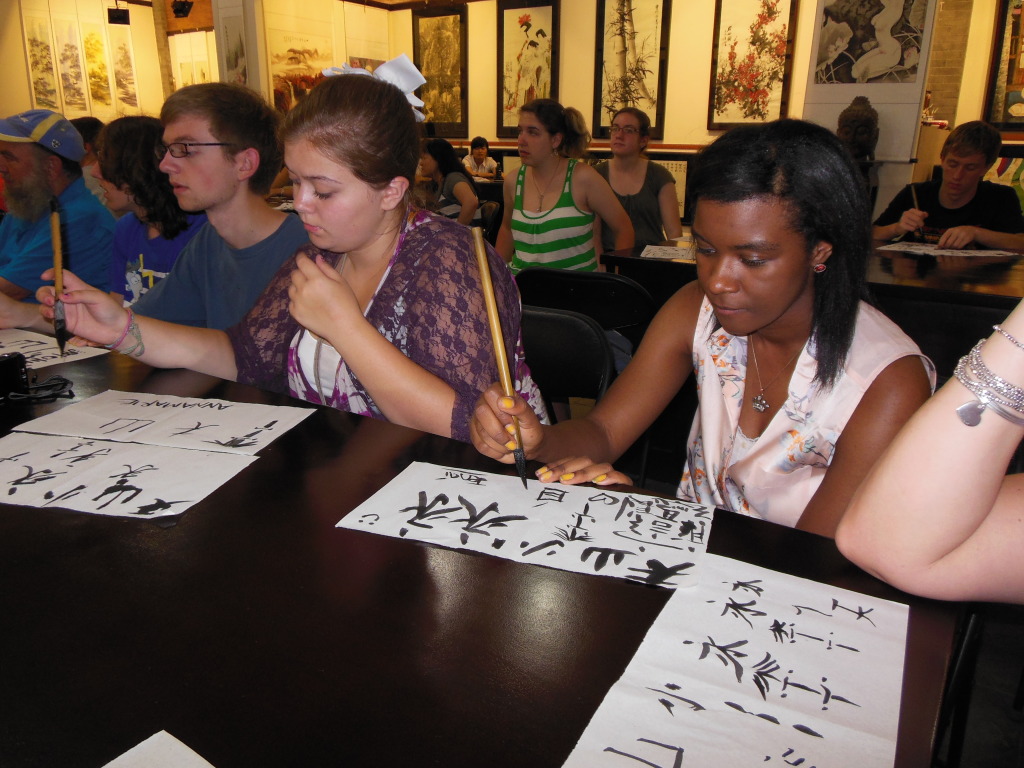
Calligraphy Lesson
After lunch we stopped a small art
museum for a tour and a lesson in Chinese calligraphy. It is harder than it
looks to write those characters with a big paint brush. Although it looked like
a few our folks were naturals.
Bike Ride on the City Wall of Xian
After an exhaustive speech on bike
safety from Arnie, we arrived at the 600 year old city wall of Xian. Here we
climbed to the top of the wall for a nine mile bike ride around the wall. I
think most of us made it all the way around. This was really terrific, because
it was like taking a tour of the city from above.
Tang Dynasty Show
Some our students and Dr. Ruther
attended a dinner theater in the evening, from what I heard it was quite good.
Hot Pot Dinner
For those of us who did not attend the
show, we enjoyed a Chinese hot pot dinner. Each of got a pot of boiling broth
and the table was filled with raw beef, lamb, vegetables, noodles, and eggs.
Michael showed us how to proceed; we enjoyed pretty good food and an adventurous
meal. Most of us agreed that the egg cooked in the broth was the best.
Day 7
Flight to Shanghai
When we arrived in Shanghai, Michael
gave us a brief history of the city and a rundown of the people. According to
Michael, Shanghai people are all about the business of making money and living
well. Michael says that Shanghai women control all the family money, he made it
sound like Shanghai was full of hen picked husbands (sort of makes you wonder if
Michael had a bad experience).
World Financial Center
Our first stop in Shanghai was the
World Financial Center, the tallest building in Shanghai and the second tallest
building in the world. We took the fastest elevator in the world to the top
where we took some time to explore the enormous skyline of Shanghai.
Dinner in the Hotel
Acrobatics Show
After dinner we went to a Chinese
acrobatics show. We saw unicycle jugglers, air wire tricks, tumblers, and
several people flying through the air.
Day 8
Introduction to Shanghai
Our last local guide joined us in the
morning, her name was Jasmine but Michael called her Peony and Chrysanthemum
interchangeably. As we rode to our first stop, Jasmine gave us a very
interesting lesson on the history of Shanghai’s Jewish community. Jewish
merchants arrived in Shanghai in the 1800’s and the community grew to be quite
large during World War II when large numbers of European refugees moved to
Shanghai. We learned that the Sassoon (Ancestors of Van Sassoon) were very
influential in the development of Shanghai’s international trade.
Jade Buddha Temple
Here we explored a large Buddhist
temple built to house several large statues of the Buddha given to China by
Burma. We learned that Chinese parents visit the temples and tie red ribbons
around the temple to pray for their children’s success on school exams.
Silk Factory
We took a tour of a silk comforter
factory where we learned how silk worms are raised and how silk thread and cloth
is made from their cocoons. Our guide at the factory unraveled a silk worms
cocoon so we could feel the tiny thread that we then watched spun together with
8 other cocoons to make one silk thread. Apparently it takes nine cocoons to
make one kilometer of thread. We also learned that they use the double cocoons
to make comforters by stretching the cocoons out, several of us got to try
this. This factory like all factories in China had a gift shop, but unlike just
about everywhere else they did not haggle on prices.
Lunch on Nanjing Road
We stopped at Shanghai’s “5th
Ave” for lunch. Jasmine warned us not to buy any European or American brands
here because they would be much more expensive than in the U.S. Even though
American clothes and electronics are made in China, the taxes make them more
expensive there than here.
Bund
We made a brief stop at the waterfront
to visit the area where wealthy European merchants had their homes and
warehouses.
Yuyuan Garden
In the afternoon, Jasmine took us to a
Ming Era family garden. We took an hour or so to explore the elaborate garden
and learn how a wealthy Chinese family in the Ming Era would have used it.
Chinatown
Our final stop in China was,
ironically, Chinatown. It seems strange at first that there is a Chinatown
in China, however if you consider that Shanghai was a concession port leased to
the British, French, and Japanese after the first Opium War it makes more sense.
This was the only area in town that Chinese could live in from the mid-1800s
through about 1945. Here we explored and shopped for about two hours. After
seven days in China, our bargaining skills had been honed to a fine art. When
we all returned, everyone had bags of treasures and each of us was convinced
that we had gotten the best price ever.
Exploring Shanghai
Several of us headed out on our last
night in China to explore the streets of Shanghai. We found three huge malls, a
park, street venders selling a strange variety to creatures to eat, and the
biggest subway station I have ever seen.
Day 9
Fight home
Our plane home was considerably more
comfortable than the one that brought us to China. We each had our own TV and
head rest that made sleeping much easier. We flew from Shanghai to Detroit were
we went through immigration and customs and then on to Atlanta.